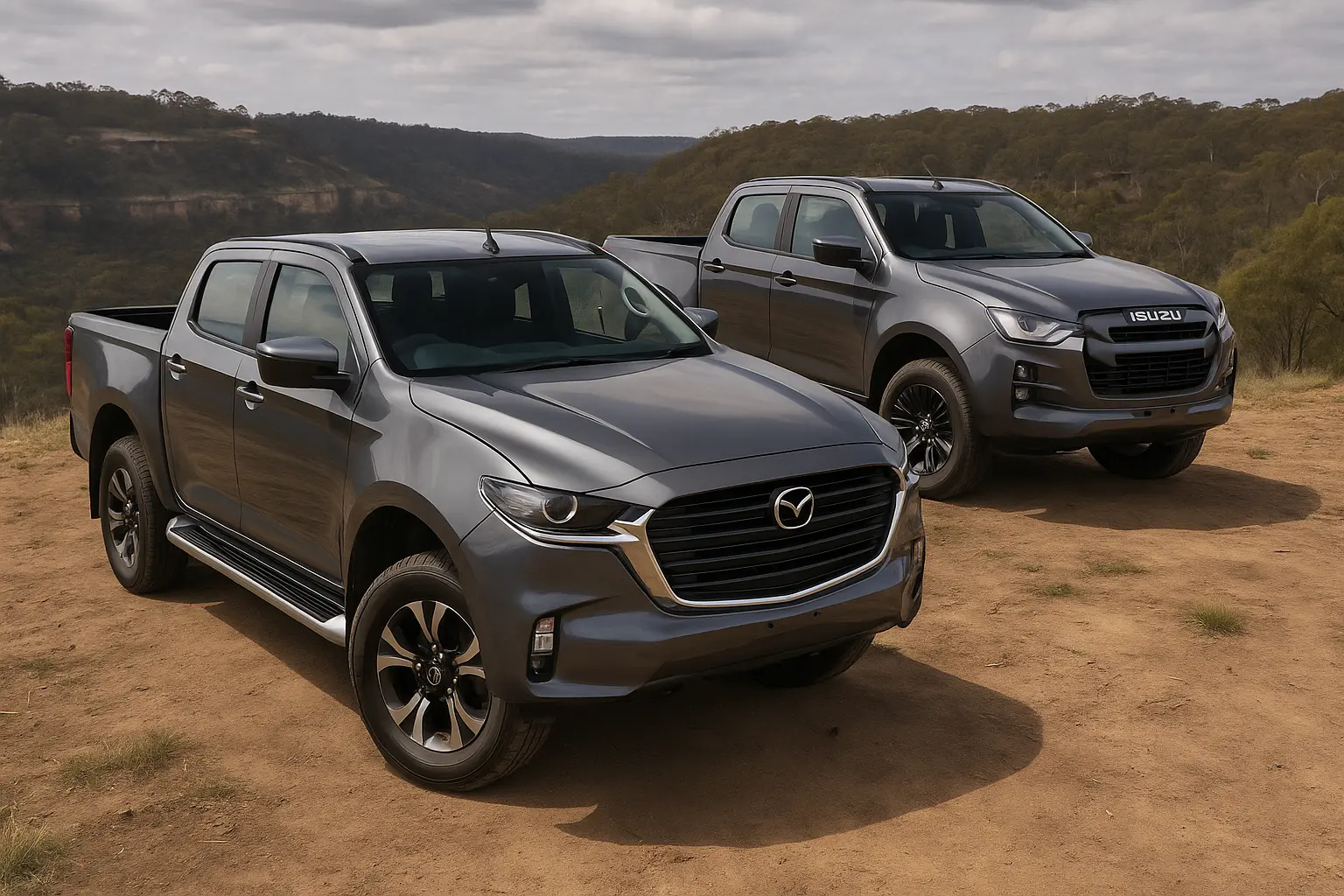
Australia’s ute market is fiercely competitive, and few matchups attract as much attention as the Mazda BT-50 vs Isuzu D-MAX. Built on a shared platform but with distinct styling, tuning, and value propositions, these two workhorses dominate conversations among tradies, off-road enthusiasts, and everyday drivers alike.
Both are tough, capable, and reliable — yet each brings its own flavour. The BT-50 leans into Mazda’s premium design and comfort cues, while the D-MAX doubles down on durability and real-world practicality. In this comprehensive comparison, we’ll explore their design, interiors, towing performance, off-road ability, safety, and ownership value to help you make the right choice.
Overview: Shared DNA, Different Personalities
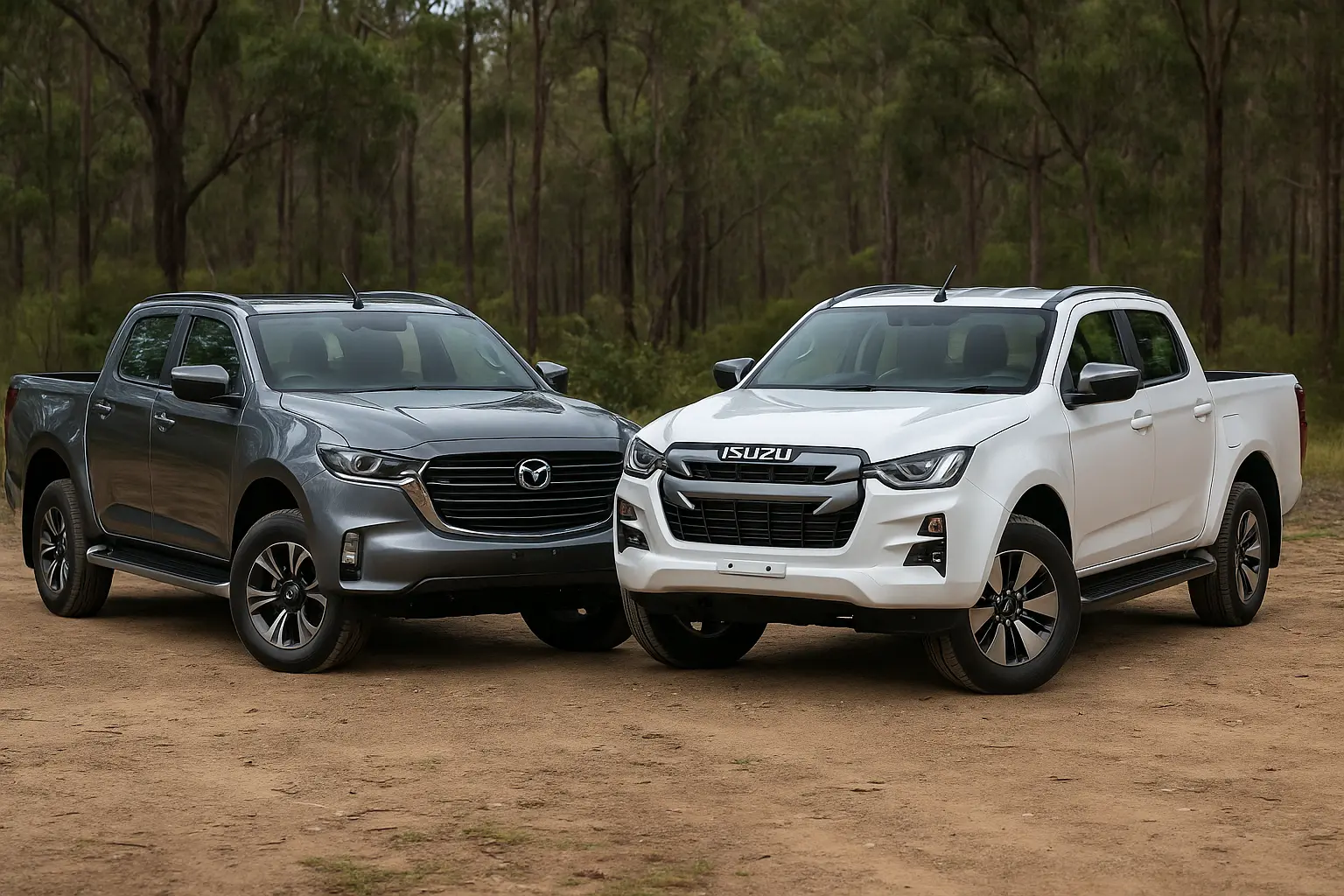
It’s no secret that the Mazda BT-50 and Isuzu D-MAX share the same underpinnings. Since 2020, both utes have been co-developed, with Mazda adopting Isuzu’s robust ladder-frame chassis and powertrain.
However, despite the mechanical similarities, Mazda has tailored the BT-50 to appeal to buyers who want a slightly more refined and lifestyle-oriented ute, while Isuzu maintains its identity as a rugged, no-nonsense workhorse.
| Specification | Mazda BT-50 | Isuzu D-MAX |
|---|---|---|
| Platform | Shared Isuzu architecture | Shared Isuzu architecture |
| Engine | 3.0L turbo-diesel | 3.0L turbo-diesel |
| Power | 140kW @ 3600rpm | 140kW @ 3600rpm |
| Torque | 450Nm @ 1600–2600rpm | 450Nm @ 1600–2600rpm |
| Transmission | 6-speed auto or manual | 6-speed auto or manual |
| Drivetrain | 4x2 and 4x4 | 4x2 and 4x4 |
| Towing Capacity | 3500kg braked | 3500kg braked |
| Payload | Up to 1100kg (variant dependent) | Up to 1200kg (variant dependent) |
The differences, therefore, are not in raw numbers but in execution, ride comfort, interior quality, and brand experience.
Exterior Design: Subtle or Bold?
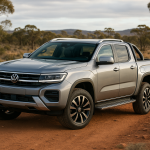
The Mazda BT-50 embraces a more sophisticated aesthetic. Borrowing Mazda’s Kodo design philosophy, it features a sculpted front grille, sleek headlights, and smoother body lines that make it look more SUV-like than industrial. It’s arguably one of the most stylish utes on the market — especially in higher trims like the GT and SP.
The Isuzu D-MAX, on the other hand, presents a bolder, more utilitarian look. Its front end is chunkier, the grille more aggressive, and the stance wider — signaling its work-ready attitude. For many Aussie ute lovers, that ruggedness is part of its appeal.
- BT-50 Pros: Premium design, smoother panels, more modern flair.
- D-MAX Pros: Rugged presence, aggressive front end, tougher look.
Verdict:
If you want a ute that looks at home in the city or on a job site, the BT-50 strikes a better balance. But if you love the classic, tough aesthetic — the D-MAX remains king of the outback look.
Interior Comfort and Cabin Features
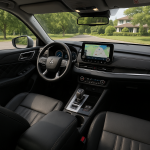
Step inside, and you’ll see Mazda’s influence immediately. The BT-50’s cabin feels closer to an SUV than a ute, especially in higher trims. Soft-touch materials, leather seats, and a premium dashboard layout make it more appealing to those who use their ute for family and lifestyle activities.
The D-MAX interior has improved dramatically in recent years, but it still prioritises durability. The dashboard design is simpler, with harder plastics that are easier to clean after a muddy off-road session.
Both models now feature a 9.0-inch touchscreen, Apple CarPlay and Android Auto, digital driver displays, and dual-zone climate control on mid to high trims.
Mazda BT-50 Highlights
- Leather-accented seats (on XTR and GT models)
- Soft-touch dashboard finishes
- 9.0-inch infotainment with smartphone mirroring
- More refined noise insulation
Isuzu D-MAX Highlights
- Hard-wearing materials built for the job
- Adjustable steering column with telescopic reach
- Excellent visibility
- Ergonomic control layout
Verdict:
The BT-50 takes the win for interior comfort and design, while the D-MAX edges ahead for practical durability.
Engine, Performance, and Towing
Both utes share the 3.0-litre four-cylinder turbo-diesel engine, producing 140kW and 450Nm — more than enough grunt for daily hauling, towing, and highway cruising. The six-speed automatic is smooth and reliable, while the manual offers great control for traditionalists.
On the Road
The BT-50 offers slightly smoother ride comfort thanks to Mazda’s suspension tuning, which favours refinement over ruggedness. The D-MAX, conversely, feels more at home off-road and under heavy load.
When towing, both feel stable and capable. Towing capacity tops out at 3,500kg (braked), with payloads of around 1,000–1,200kg depending on the variant.
The D-MAX has a small advantage in towing stability due to its rear-suspension calibration and slightly firmer setup. Mazda’s model, however, is quieter on the highway and more comfortable for long trips.
Fuel Economy
Fuel use is virtually identical, with both averaging 7.7–8.1L/100km depending on driving style and load. The manual variants are marginally more efficient.
Verdict:
For everyday towing, either ute will perform reliably. But if your weekends involve serious off-road caravanning, the D-MAX’s firmer suspension and proven track record give it the edge.
Off-Road Capability
Both utes are serious off-roaders, built to handle Australia’s toughest terrains. With 4x4 systems offering high and low-range gearing, rear diff locks, and hill descent control, they’re equally capable on paper.
Key Off-Road Specs
- Ground clearance: 240mm (BT-50) / 235mm (D-MAX)
- Wading depth: 800mm (both)
- Approach angle: ~30°
- Departure angle: ~25°
- Rear differential lock standard on 4x4 variants
The D-MAX, however, has more off-road tuning heritage. Its traction control calibration feels better tuned for slippery tracks, and the underbody protection is slightly more comprehensive.
Mazda’s BT-50 is no slouch though — it performs admirably on gravel and sand, with smoother throttle response that makes it easier to control on uneven terrain.
Verdict:
The D-MAX wins narrowly for pure off-road ability, while the BT-50 is better for everyday ride comfort and weekend exploring.
Safety Ratings and Driver Assistance
Safety has become a top priority in the ute segment, and both models lead the class. Each received a 5-star ANCAP safety rating, backed by comprehensive active safety tech.
Shared Safety Features
- Autonomous Emergency Braking (AEB)
- Lane Keep Assist
- Adaptive Cruise Control
- Traffic Sign Recognition
- Blind-Spot Monitoring
- Rear Cross-Traffic Alert
The Isuzu D-MAX introduced this impressive safety suite first, and Mazda followed suit. Both provide excellent visibility and driver assistance, though Mazda’s tuning for adaptive cruise and lane keeping feels smoother in urban driving.
Verdict:
A draw — both deliver segment-leading safety and are ideal for family or fleet use.
Variants and Pricing in Australia (2025)
The BT-50 and D-MAX ranges mirror each other closely, from entry-level workhorse models to top-tier lifestyle trims.
Mazda BT-50 Pricing (approx.)
- BT-50 XT (4x2 manual): from $38,500
- BT-50 XTR (4x4 auto): from $56,000
- BT-50 GT (4x4 auto): from $63,000
- BT-50 SP (flagship): from $68,000
Isuzu D-MAX Pricing (approx.)
- D-MAX SX (4x2 manual): from $37,800
- D-MAX LS-U (4x4 auto): from $55,000
- D-MAX LS-T (4x4 auto): from $63,500
- D-MAX X-Terrain (flagship): from $67,500
Prices vary slightly by state, dealer, and drive-away offers.
Verdict:
The D-MAX usually undercuts the BT-50 by a small margin at equivalent trim levels, making it slightly better value for money.
Ownership Costs and Warranty
Both utes are evenly matched on running costs and warranty coverage.
- Warranty: 6 years / 150,000km (both)
- Service intervals: 12 months / 15,000km
- Capped-price servicing: Available for first 7 years
Isuzu’s strong reputation for reliability gives it a slight advantage here, as it’s long been known for bulletproof diesel engines. Mazda’s ute is newer to this platform but backed by the brand’s premium customer service approach.
Verdict:
Both are low-maintenance choices, but the D-MAX wins on long-term durability perception, while Mazda shines in dealer service experience.
Technology and Infotainment
Tech is an area where both have stepped up significantly.
- Infotainment: 7.0-inch (base) or 9.0-inch (mid-high trims) touchscreen
- Connectivity: Apple CarPlay (wireless on top trims), Android Auto
- Sound System: 8-speaker premium audio (GT/X-Terrain)
- Display: Digital driver cluster, reversing camera, optional 360° view
Mazda’s user interface feels slightly more polished, with smoother graphics and menus. Isuzu’s software is practical but occasionally slower to respond.
Verdict:
For tech lovers, the Mazda BT-50 edges ahead with a sleeker system, while the D-MAX’s setup is simpler and more robust.
Everyday Usability
When it comes to everyday usability — parking, cabin access, tray practicality, and visibility — both utes perform well.
The D-MAX’s tray is slightly wider, making it better for carrying bulky loads. Mazda offers more stylish accessories and interior comfort options, targeting family buyers and weekend adventurers.
Both come with excellent driving ergonomics, making long trips comfortable, and both are easy to live with around town despite their size.
Verdict: Which Ute Should You Buy?
Choosing between the Mazda BT-50 and Isuzu D-MAX comes down to your priorities.
- Choose the Mazda BT-50 if: you value premium styling, interior refinement, and a more comfortable on-road experience.
- Choose the Isuzu D-MAX if: you want rugged dependability, proven reliability, and a ute that’s slightly better suited for tough work or remote adventures.
Ultimately, they’re two of the best utes in Australia, sharing the same heart but expressing different personalities. Mazda brings style and sophistication; Isuzu delivers unbreakable toughness.
Whichever you choose, you’re getting a capable 4x4 ute that can tow 3.5 tonnes, tackle the bush, and cruise the highway in comfort.
Final Thoughts
The ute segment in Australia continues to evolve, but the BT-50 and D-MAX duo prove that reliability and practicality still matter most. With advanced safety, tech, and off-road credentials, they remain a top choice for anyone who needs a vehicle that works hard and plays even harder.

Leave a comment
Your email address will not be published. Required fields are marked *